When I rented a car at the Tulsa airport, I knew I was dealing with an officious company when I told the clerk my phone number and said she needed two.
“I only use a mobile phone,” I lied.
“We need two. It’s policy. In case you don’t return the car.”
(“I could just give you a fake number,” I thought.) I gave her an old number.
Then she demanded a street address.
“But my credit card goes to my P.O. box,” I said. I only give out my post office box when I’m dealing with strangers away from home. It’s even on my driver’s license.
“It’s policy,” she said. “In case you–”
“Steal the car?” I finished. “I could just give you a fake one.” I really said it this time.
“They make me take it,” she confided. She was young and sweet, probably wanted a nap, and all she was missing was a wad of chewing gum to smack. I smiled and we laughed together. I couldn’t blame her for this invasion of my personal details. She was merely the legally ill-advised foot soldier.
We plowed through a few more options (decline CDW, I said, since my credit card covers it; yours probably does, too). Then:
“Are you going to pre-pay gas or fill up yourself?”
“I’ll fill up myself.”
“Then you have to bring the receipt for gas back with the car and show it to the attendant who checks it in.”
“What! That’s new! Why? That seems crazy!”
“Yeah, it’s kind of a new policy because people were filling up the tanks with other fluids.” She jerked her thumb toward the Dollar desk. “They’re doing it, too.”
“Really? I hadn’t heard that. Wouldn’t messing up the engine of your rental car be illegal? Isn’t that why you take my credit card?”
“Yeah, and they just need proof that you filled up with gas,” she said.
“It sounds like it ought to be a matter for the police instead.”
She shrugged. I signed. Vexed as I was by this triple presumption of guilt by Thrifty Rental Car, and as annoyed as I am to be forced, DMV-style, to prove my innocence through unnecessary paperwork, I needed the car I had reserved. I’ll assume other annoyed customers like me submit for similar reasons.
“This makes me just want to use Avis next time,” I said with an outward laugh.
She wrinkled her nose. “Yah, but we’re cheaper.”
Down at the pick-up desk, I asked a second employee how long this rule had been in place.
“More than a year,” she said, before plunging into an unasked-for explanation. “It’s for your own protection. It’s the only way to make sure the gas tank is actually full because the gauge isn’t always accurate. We get a lot of businessmen who drive around and don’t fill up but the needle’s still on full.”
Not only was this second explanation wormy — so which was the real reason? — but it also made no sense. (Whenever the phrase “for your convenience” appears, you can bet it’s to mask the real reason, which always benefits the company instead. When you hear that, scrutinize.) And in this case, having a receipt would not prove the tank was full, only that gas was purchased at some point. I was given no time parameters for when I’d have to get that receipt, after all.
“That’s funny. The girl inside told me it was because customers are fling the tanks with other things.”
She frowned. “Oh. She wasn’t supposed to tell you that.”
Update: I’m hearing reports that Avis does this now, too. Which other renters also do? Update to that update: That Avis demand was just a rumor. Looks like Thrifty/Dollar stands alone.
Update 2: When I returned the car, the clerk didn’t ask to see it. She also didn’t check the mileage or the fuel gauge. Her computers were down so she virtually waved me through.
I traveled to rural Tennessee to cover a uniquely American shopping experience: a yard sale, annually held over the first weekend in early August, that spans some 675 miles of one highway. It’s called, not undeservedly, the World’s Longest Yard Sale.
We can feel comfortable that the Chinese are unlikely to covet this world record and swipe it from us, partly because they made most of the junk for sale at this one.
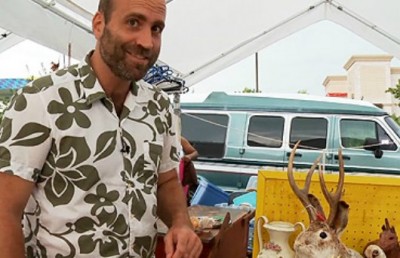
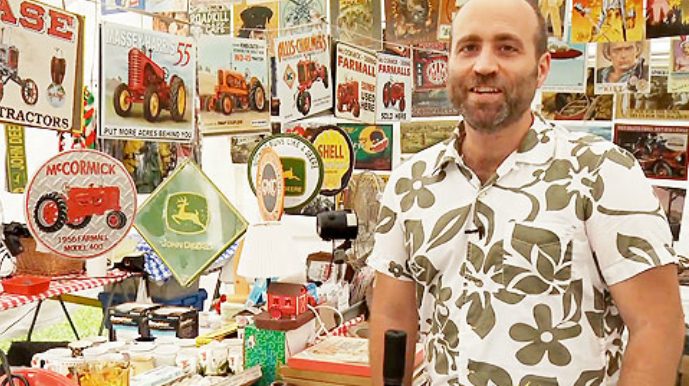
These funny short segments star the Tennessee locals, me, and one of the loudest jungle shirts known to mankind.
No, I did not pick it up at the yard sale. Yes, I think I risk turning into Al Roker.
Three videos emerged from the mayhem. The first one’s a panorama of the scene. What I say at 1:29 of that one sums up how I feel about this phenomenon.
The second focuses on smart tips for every rummage sale shopper. The woman who ran the booth I’m shooting in at 1:06 got really hacked off about what I said. She overheard me and thought I was talking about her (I wasn’t) and came in for the kill right as I finished my line. My videographer and I high-tailed it out of there — much like a jackalope might, I surmise, when a careless price tag-bearing granny unboxes it — as soon as the take was done.
I especially love the gag at :44. Thank the talented editor Matt Crum for the punch of that one. His collaborator in this silliness was videographer James Houk — hire him, because he caught a lot of brilliant shots and did it in extremely trying, sweat-soaked circumstances. (Love the dinosaur peeking out of the box!)
Finally comes the third one. I particularly like the part where I sell the guy his own knives and the geezer, at :40, who seemed to relish his on-camera debut. Also loved my weird use of the word “ire” in conversation with a game bric-a-brac vendor. And his witty touché about being pretty or being nice.
Cheapskate camouflage: Can you distinguish my wardrobe from the other tacky crap?
Yes, I had a total blast. Can’t you tell? I mean, the shirt pretty much screams “are we having fun yet?”
Of course I get depressed sometimes. Everyone does, or, I’d like to think, the most interesting people do. I have lived in Manhattan for almost all of my adult life.
Whenever I get fed up with the tiny apartments, the neglected infrastructure, the fact many of my most brilliant friends are barely scraping by, or the robotic crush toward trendiness by its misguided and over-moneyed youth, I take a walk. I can roam anywhere in Manhattan, but nearly everywhere I go, I only have to do one thing to feel thankful again.
All I have to do is look up at the Empire State Building at night, and wait a few seconds.
The sight of the Building itself isn’t always enough to lift my spirits. It’s beautiful and miraculous to the eye, to be sure, but it’s become furniture to me. And after 9/11, I can’t look at it without the half-clouded fear that it, too, will be taken away from me, leaving me without another of my guideposts.
No, I stare near the top of the building, especially in twilight. If you look in the vicinity of the observation deck for more than five or ten seconds, you will invariably see a flash go off. Often, you’ll see a few, and they continue until midnight, when the deck usually closes.
The flash comes from a tourist’s camera. The flash is evidence that they are so thrilled, so fired up, so overwhelmed with gratitude for the seemingly infinite cityscape laid out before them. For those trying to preserve the sight of the cityscape far below, the building is too tall, and stands too alone, for the flash to have much effect on a photograph. The flash is an illogical slip in the face of profound overstimulation.
Whoever set off that flash is probably flooded with thankfulness and romance. They might have saved up for years for the chance to come see New York City for themselves. And now they’re up there, surveying my home and trying in vain to take it all in.
They are trying to soak up every second. When I’m feeling gloomy, they are more rooted in this moment than I am. They’re here.
So when I see it, I am reminded of how grateful I myself am. I’m here all the time. That landscape, the one people dream about and fail to fully comprehend, is my home.
And as I watch the twinkle that comes from the breathless observers of my city, I am returned to openness myself.
In its response to me, Delta doesn’t deny that it delivered two conflicting prices to me. But Delta claims that the difference happened because the price of the flight fluctuated while I was searching. It wrote, “it appears that during the short time between your searches (according to our logs it was about 11 minutes), the inventory for that flight changed and a lower-priced fare class (a T class) became available. The change in the lowest-available fare was unrelated to SkyMiles status.”
There are a few things I find ludicrous about this attempt to defend the discrepancy. One is that Delta claims the elapsed time between my flight checks was 11 minutes. I searched immediately, partly because I was in sticker shock and partly because, as a consumer reporter and a travel writer for more than a decade, I am perfectly aware that prices can change at a moment’s notice. I went back and forth between the browsers, double-checking, which means there were at least three searches by me; I screen grabbed only the last ones I did while they were still on the screen.
Then again, the airline also hedges by saying “it appears” this was the case. It can’t be sure.
But I didn’t expect anything different. Delta just gave one of the standard-issue excuses that all airlines give when they’re accused of fare shenanigans:
“Prices are always changing.”
They can weasel out of a lot by claiming that, and because they keep the pricing opaque, customers can’t fight back with any facts.
“We realize that airline fares can be complex and can fluctuate,” Delta continued, (and, although I’m defensive, somewhat condescendingly), “which is why if you find a lower fare by 12 midnight Eastern Time on the same day you purchased your ticket at delta.com, you can access your itinerary via delta.com and click on the “Change Flights” button. Your new fare will be ticketed and the refund for the difference in fares will be credited to your original form of payment.”
Nice to know. My translation: “We know we’re incredibly confusing and our pricing may indeed screw you. That’s why we give you a chance to do even more research and clean up the mess as long as you do it by midnight.”
There are two other all-purpose excuses the airlines use to get out of consumer complaint—legally.
“We’re just keeping up with our competitors.”
That’s how, minutes after the FAA stopped charging tax on flights this week, Delta (and other airlines) raised fares by exactly the same amount, pocketing $200 million a week.
The airlines, with few exceptions, claimed they couldn’t give consumers a break because none of their rivals were. (That doesn’t make much sense to me. You’d think the airline that’s cheaper would win in the marketplace. But things don’t have to make sense in Airline World. They just have to be legally defensible. And profitable.)
It’s worth noting that Delta and AirTran are both reportedly under investigation by the Antitrust Division of the Department of Justice. Also, a judge rules that a class action lawsuit, filed by passengers who accuse the two of colluding to institute baggage fees at the same time in 2008, may proceed.
The other all-purpose excuse the airlines use to dodge sketchy behavior?
“It’s the weather’s fault.”
That’s how, last December, I was stranded at JFK for 32-plus hours when Virgin Atlantic refused to let me out of a flight even though it was scheduled to depart at the peak of the snowstorm of the decade. And once it marooned us, there were no blankets and no food. Irresponsible? Yes. But if an airline finds a way to blame the weather, as Virgin Atlantic did, the government can’t punish it. This one often works even if the skies above your airport are crystalline clear and the bluebirds are chirping sweetly — surely you’ve been handed this excuse on an apparently beautiful day. You can’t speak for what the weather is doing somewhere else.
These excuses are pretty much iron-clad. Why? Because you can’t prove them false. You aren’t privy to the truth.
Take a look at the screen grab below. To the left is an air ticket priced by a passenger who is signed in as a Delta Air Lines frequent flier. To the right is the same itinerary, except this one is quoted on a separate Web browser, without signing in. They were priced at the same time.
Delta wants to charge the passenger who signed in $79.30 more for the same flights.
The search happened when the passenger needed to change an existing reservation. Notice that the first legs on these itineraries register as a different fare class (T or K). For whatever reason, the frequent flier was not offered the lowest-priced fare leg. (Nice catch, @SimonTravels.) That bumps up the cost of the ticket for the SkyMiles member by nearly $80.
How much does Delta stand to make from all the passengers who fail to notice this discrepancy? Few customers do price checks in separate browsers when they need to change a reservation, so ripoffs like this, if they happen, go undetected.
When Delta was telephoned for a price quote of the same flights, the lower price was offered there, too.
The cheap price simply wasn’t given to the person who had signed in as a customer and attempted to conduct a flight change online.
Let me reiterate my common warning: Whether it’s intentional or not, online airline pricing is a shrouded world prone to shifts that will rarely be in your favor. Always check your flight reservation prices on several browsers, including one without cookies enabled and with the cache cleared.
If you’ve ever searched for an airfare and seen the price suddenly leap higher when you went back to double-check an earlier option, you know how manipulatable, and how unreliable, online searches can be. Always go to a brand new browser and compare what you get there.
And if there is any disparity, contact the airline. In Delta’s case, it honored the lower price, although so far it has not accounted for how this highly suspicious overcharging happened.
Delta’s customer service Twitter account, @DeltaAssist, is looking into this. The phone rep apologized “for the inconvenience” but admitted no fault.
Left: Signed in. Right: Anonymous on another browser. Frequent fliers are asked to pay nearly $80 more without being offered the cheaper option. Click to embiggen.
Update: @DeltaAssist offered the following excuse by Twitter DM: “Fares fluctuate based on avail – not on whether you’re a SkyMiles member or not. When you reissued your ticket you got it at $528.80 … If you were to reprice now, that fare class is no longer avail which is why it’s more.”
My response: “These were checked simultaneously. How do you account for differing fare classes offered to me?”
For my readers: The lower price was obtained only after I discovered (through the second browser) that it was available, and I phoned Delta to object. Both fares were double-checked. First, the signed-in quote, then the anonymous/new browser one, then back to re-price the SkyMiles quote. Neither quote budged over the course of it. At that point, the screen grab was made, so claiming fluctuating fares as a defense is not a realistic in this case. The issue here seems to be one of fare classes being offered (K versus the cheaper T), a facet of the query that Delta has so far not addressed.
Your biographer is screwed. You are leaving nearly nothing behind.
While you pour your energies and thoughts into the machine sitting in front of you, you are leaving nearly nothing about you that your descendants will be able to find.
You know it’s true. Compared to your parents, or your grandparents, what are you handing down besides possessions? Most of us have trouble locating email folders that are just five years old. Yet thanks to old-fashioned pen and ink, historians can still account for the day-to-day activities of everything from the backstage staff at Ziegfeld’s New Amsterdam to the most lowly privates marching in the Civil War to the art acquisitions of the Kings of England.
Impermanence abounds. You write no letters, preferring email. You send no cards, choosing instead a quick Facebook wall post. There are no romantic proclamations, wrapped in ribbon at the back of a drawer, to be burned upon your death. You have left nothing like that behind.
My own journal writing tapered off neatly as the Web rose. That’s how most of us use our free time now, not by collecting and sorting our thoughts and feelings. Most of us journal only via status updates. Set aside the fact you watch too much TV and surf the Web too much. It’s doubtful that you kept a journal anyway. You will probably say that life is too busy.
We read books by Kindle, accumulating no libraries. We cannot make notes in the margin to edify their future owners of our books or reignite ideas in ourselves later. We cannot write meaningful inscriptions or dedications when we share books that offer ideas friends will love. Amazon has even decided to take back some of the books we buy. Our personal libraries are becoming merely borrowed information, never rendered truly ours or integrated with the contours of our lives. Our public libraries cease to exist altogether, or have halted in their development.
Today, Borders bookstore announced the total liquidation of all its stores, further forcing more Americans to buy their reading material digitally. Digital media, or the failure to harness it, are being blamed, but we all know that people are reading less and watching more. Rented intelligence, rented experiences.
The songs we buy are a forgotten password away from oblivion. We no longer even purchase movies much; instead, we scrub through our entertainment by remote control, skipping through entertainment episodes. We live and die by what can be related over the water cooler, which is often the program that was on last night but will be forgotten in a month.
The great influencers of our time shout into microphones. They don’t pour their thoughts onto paper where they can be debated for years into the future. All of our fine thinking is gone with our hot air.
At Luxor, Egypt, where they know how to leave stuff behind, in 1998
Your photographs don’t exist. Almost none of them have been printed. They are merely a temporary collaboration between light and data. The very memory of you is being stalked by a 404. In fact, every digit on our computers, which contain nearly every detail a biographer would find interesting, can vanish into the memory hole with the wave of a single magnet.
Stop and think how much you’re leaving behind. If someone were to write a biography of you in 100 years, what would they be able to use? Do you keep papers? Do you write notes? Without an electrical outlet, will there be any evidence that you existed?
No librarian has yet solved the problem. Just as every American over 30 occasionally runs across a plastic floppy disk from the past yet has no way to read it in the present, the historians in charge of maintaining our very history are finding the rapid turnover of technologies and the uncertain degradation rates of digital storage media to be no match for the dwindling government funding allotted to making sure we don’t lose it all. The Library of Congress has an entire Preservation department dedicated to placing bets on emerging media and making sure the stuff used just a decade ago doesn’t becoming inaccessible forever.
Trying to get ahold of our impermanent artifacts is why, last year, the Library of Congress acquired all the public tweets ever sent. The chatterboxes of the bloggerati scoffed, but in fact, the staff there is concerned about how we are becoming historical ghosts. They are desperate to find a way to preserve the details of our day-to-day lives, now that quill and pen and Bic have all become only occasional tools. Just when they find a disk method that works, technology “improves,” and evolves the holdings right into obsolescence. There isn’t enough tax money to make sure we keep our archives current. So with every warped analog tape or time-damaged disk, our history is at risk, too.
Corporations collect purchasing information about us daily, but chances are none of it will be available to anyone once it’s no longer useful for selling us stuff. In an ignored but urgent issue I covered last year, creditors pull the plug on servers containing local newspaper archives the minute they go bankrupt. Your fears, your dreams, your challenges, your perceptions — what’s being recorded in a way that can be read, and most importantly felt, years from now?
Genealogists get frustrated because can’t learn much of our early American ancestors. Baptism records, marriage records, census entries, death notices. That’s because many of our ancestors were unremarkable, historically speaking. Because few left papers behind, their legacy of proof extends mostly through what the government or the church collected from them — provided it wasn’t burned or lost since.
Now we have great recording and cataloging tools available to us. Our fingers are touching the buttons of these tools every single day, including right now at this very second. Yet we are leaving nothing more behind than our indigent farmer and immigrant progenitors did. Will you be as mystifying and faceless to your future family as your 1820s ancestors are you to? If you are, will it be your fault?
Because I now end this post with a stroke of my keyboard, using a period that doesn’t truly exist on a disk that can be wiped out by enemies ranging from solar flares to Breakfast Blend coffee (please print this post for me), I prove my point.
Leave behind no evidence and there can be no true conclusion
Johnny Carson invited his best guests to sit on the couch. Jon Stewart invites his best guests for extended interviews to “throw online.”
I tweeted this thought a month ago. But Twitter is like a great trash compactor for complicated thoughts: It compresses them, it grinds them into something you can flush away, and it gets rid of them. Blogs are better for digestion.
It’s true about Carson, isn’t it? It was a gesture that every American understood to be a mark of greatness, like winning an Oscar. If Johnny Carson liked your comedy, he anointed you the Next Big Thing by inviting you to come chat, as a come-down, on his couch. He put David Letterman, Ellen DeGeneres, Jerry Seinfeld, and Drew Carey into overtime.
Jon Stewart has been called the Carson of our day for his versatility, affability, popularity with guests, and most of all, his cultural influence. But he doesn’t have a couch to invite his favorite guests to. He doesn’t even have time. Wheres Johnny had 60 and sometimes 90 minutes to play with, Jon has less than 30, and only one slice of his show is for guests.
So how does Stewart invite his guests into overtime? Buy granting them literal overtime. His favorite guests, and the ones with the most absorbing and complex stories to tell (or the ones that show off Stewart’s curiosity and/or incisiveness), are awarded another few minutes of interviewing time that are excised from the broadcast version but uploaded on The Daily Show website. In fact, it’s in those non-broadcast minutes that Stewart most often holds controversial guests’ feet to the fire.
To whom has Stewart bestowed this honor recently? Newt Gingrich, Bill Kristol, Donald Rumsfeld, and Jim Cramer. Like Carson’s choices for further intimacy, they all reflect Stewart’s tastes. Stewart selectively invites comedians for extended interviews, the way he did with his Iranian counterpart satirists Kambiz Hosseini and Saman Arbabi. Usually, they’ve got to be as trenchant as Stewart himself.
It was once a badge to get clubby with Johnny on the upholstery. Now, the sure sign that you’re fascinating is that your bon mots are available only to the devotées who go to the online clubhouse.
Of course, I didn’t have to tell you that the Web is the new couch. You sit here all day.
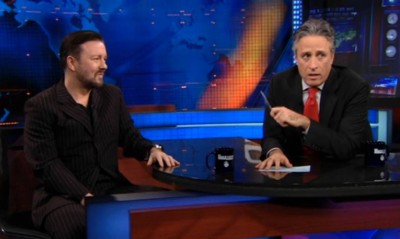
Congratulations, Ricky Gervais! You've gone into overtime and you'll be "thrown on the Web". This just might mean you're a success.
Every Ricky needs a Rayanne — or at least he used to
Here’s what’s going to happen. Some gay kids are going to start realizing they weren’t gay after all.
Most sexually questioning teenagers, even in the most conservative high schools, make friends with the misfit girl who appreciates both his plight and the fact he’s not a sexual threat to her. And the minute a young teen boy starts experimenting sexually, as teen boys do, those Best Girlfriends are there to support and applaud. A generation ago, that best friend might have reacted with shock, or looked the other way.
But today, all a boy has to do is so much as get caught glancing at the cool jock at summer camp, as teen boys do, and he’ll be met with a chorus of friend encouragement, assuring him that he can be who he wants to be without losing their love. “Omigod! You’re totally gay! That’s awesome! Ask him out!” So teen boys dabble, as teen boys do, and pretty soon, because his friends have been so aggressive about their support, he’s “gay.”
By now, we’re several iterations past Angela Chase and Ricky Vasquez. The gay boy/supportive girl relationship has become a cultural archetype. Rachel Berry and Kurt Hummel don’t spend much time grieving to gay wounds; they compete like savages for the chance to sing “Defying Gravity.” The kids coming up today view even Will & Grace as an antique. And so will we all, I think, with time. These characters were created to make statements about our era, but the truly shifting nature of human sexuality has been de-emphasized as long as there was a political-social point that needed to be made.
These days, with anti-gay bigotry so readily available from the older generations, many younger people think it’s something of a political statement to show rainbow flag-flying support for their sexually emerging peers. Homophobia from elders has made homophilia among teens a statement of their impending social triumph.
Okay, maybe not them.
But what teenager knows who they truly are as a bottom line? I predict that the vocal support that comes from high school peers may, in fact, be hasty for some people. It will, for some, have a bounceback. Because some of those kids truly were merely experimenting and got locked into a self-definition by the sheer force of social acceptance. With kids coming out earlier and earlier — as soon as puberty hits, in many cases — confusion is bound to happen.
It’s not that they’ll be going back into the closet, per se, because that would imply they are returning to hiding. Instead, some kids will undergo a sort of “hetero correction.”
And that will present a whole new set of acceptance challenges, because some of us have grown so conditioned to supporting coming out of the closet that we’re a little suspicious when someone realizes they never had a closet to begin with. What’s more, in conservative communities, the upstream-swimming self-hatred that’s nurtured by the “ex-gay” movement has tainted the motives of any return to heterosexuality that a person might genuinely feel inclined to make.
I’m a little nervous even positing this scenario, less someone accuse me of making apologies for coming out of the closet, or suggesting it’s “better” if kids were straight. I’m not suggesting anything like that, of course. If anything, I’m validating the Kinsey Scale, and acknowledging that if it’s true, then some people will find themselves wanting to wander back to the other end of it, but finding their environment, for heretofore necessary social reasons, may be resistant to a sexual re-definition that travels the other way.
Bryan Elsley, the co-creator of Skins, feared just such a thing last year when his lesbian character Tea Marvelli (Sofia Black-D’Elia) developed conflicting emotions after messing around with a boy. “We’re just trying to express how screwy people’s lives can be,” he explained to Entertainment Weekly. “We’re hoping that people in the gay community will recognize something in those stories.”
Don’t shut that closet door on your way out.
Could you trust someone who spent years waving a rainbow flag when they say they’re now in love with a woman? Some of the cornerstones of gay political ideology — indeed, the core emotional principles behind the validation of gay marriage — are that love is mutable, people are people no matter their gender, and that it’s the human condition to love another human.
Will gay people, hardened and made suspicious by years of fighting bigotry, be able to embrace their friends who decide there is a place for the opposite sex in their lives after all? Will the opposite sex trust it, either?
Now that gay marriage is being validated on a wider scale, and building a defensive fortress around sexual identity is slowly (verrry slowly) becoming less necessary, over the coming generation, gay people will have to find new ways to define their own sexuality that doesn’t pitch them versus the rest of the world. Gay bars are dying around the country because kids are comfortable mingling everywhere. Mental desegregation may follow. And hallelujah for that.
Cracked in the head, but a historical document nonetheless
Although a whole lot bothers me about musicals, there are some things that I love, specifically, what stems from history. I almost never listen to a cast recording and get goofily carried away. I start thinking about the place and time of it, the look of the cabs that passed outside the theatre, the hats and coats on top of the heads of the audiences and the political and social concerns inside them.
I like the document of the cast album. It’s so rare to allow history to sing in your ear.
As a document, the original cast recording of 1971’s Follies was shredded from the start. People now acknowledge that the show is, if not really a perfect masterpiece, then one of Stephen Sondheim’s most compelling, and widest-ranging. Its daring was what turned people off: It’s about middle-aged people having nervous breakdowns when they return to an abandoned theatre, Weissman’s, that once was the centre of their young romantic lives. At the end, a demo crew breaks through the wall and everyone leaves, shattered. Wheee!
The promise of self-doubt and meltdowns with top hats (particularly during Vietnam, when the middle class had enough to regret) didn’t appeal to many people back then, so it wasn’t destined to run for long. And the show’s casting, scenic, and narrative demands are extreme enough to mean the show is rarely revived, perhaps rightfully so, which makes the original production a brief flash of mythology for New Yorkers and singers alike. But in 1971, as it was running, of course no one knew how hindsight would inform its legacy, or that “I’m Still Here” would become a standard.
So everyone allowed themselves to be stupid. Harold Prince was in a snit over something CBS had done with one of his forevermore forgettable movie ventures. CBS’s Goddard Lieberson was the undisputed master of cast recordings, but Prince was so pissy he didn’t care. So he gave the recording rights to Capitol, which had experience mostly in cynical commercial pop recordings — not in documents. Those Hollywood Boulevard types didn’t understand that cast recordings are, in a sense, snapshots of a moment. They are museums to a work of art that will only exist in that form once. They pay homage to specific cultural and economic conditions as much as they strive to entertain eccentric grandmothers and closeted future showboys.
Anyway, the lush and rangy score was hacked, compressed, and disemboweled to fit on one tinny LP.
See? Musicals are too culturally relevant! They're even on the cover of TIME! What's more culturally relevant than that? (Oh... wait...)
For the recording, Capitol rented a ballroom at the Manhattan Center on 34th near Eighth Avenue. The venue itself was a ruined theatre, having been built by Oscar Hammerstein I in a failed bid to unseat the Metropolitan Opera as New York’s dominant opera institution. Today, in further proof of the continued re-ascendancy of vaudeville-by-television, the building is where America’s Got Talent has its annual New York auditions.
A year before, CBS gave Sondheim’s Company 18 and a half hours of recording to get things right — which they needed, considering how drunk Elaine Stritch was — but the more complex and orchestral Follies was given just a single day to nail everything and clean up. In his book Everything Was Possible, Ted Chapin remembers it was a day of buzzing mics, flipped switches, and crossed signals. Not only was everything cut to hell, but people had only a few minutes to record unfamiliar, newly gutted versions of their songs before hitting the street again.
Even the album cover was lazy: the show’s poster was slapped in the middle, not even cropped, so there were long white spaces on either side.
On YouTube, I found some files by JonthesYT, a guy I don’t know, but whom I know I already love. A true historian who appreciates that cast recordings are perhaps more about American cultural preservation than mere entertainment, he has created the Follies original cast album the way it should have been. By mashing up, deftly and with an engineer’s ear, the original truncated disc with good-quality live recordings of the short-lived 1971 show in performance at the Winter Garden Theatre, he has matched the performances as they truly are.
Here’s the musical triptych of “Rain on the Roof,” “Ah, Paree!”, and “Broadway Baby.” In 1971, only the second two were included, and “Broadway Baby” was chopped in half.
From a custodial point of view, it’s horrifying to think that “Broadway Baby,” which is now a familiar tune that’s regarded as an American classic song, was not recorded in its full form by the person who first sang it. The person who first sang it, Ethel Shutta, is also fading away thanks to a lack of documents preserving her, even though she was a fixture on American stages and radio for some 73 years.
Thanks to Capitol and Hal Prince’s hissy fit, we were deprived of that artifact. But this guy has re-assembled it and restored it, with dozens of hidden edits in each track, to a sense of its truth, if only on YouTube.
My favorite one is “Losing My Mind” by Dorothy Collins. It’s already one of my favorite songs, but her little step-up on “mind” at the end of the bridge (which wasn’t recorded but was rescued from a live performance) is an interpretation I’ve never heard before. Now, I realize that had this bridge been recorded, every girl singer since 1971 would have sung that lick. Because that’s what we do, like it or not: We sing like the original sang it. Further proof the cast recording is a more powerful document than a pop song: it guides interpretation forever.
It’s a stupid little thing, really, and it may be something that only musical fans will appreciate. But it’s at 2:55:
I suppose there is an argument to be made for the idea that because Follies‘ original document was so awful, people have spent decades re-inspecting the work and trying to redeem it. And without James Goldman’s sometimes hard-to-swallow book to compare beside the score, Sondheim gets all the glory, while regional theatre companies everywhere fail to realize the many hazards that prevent the final piece, once mounted, from connecting the way they hoped it would. Thanks again to the document of the cast album, for boosting life where previously there may have been only shame.
People love to mock musicals. Even the people in musicals mock musicals, because they don’t want to be seen as so unhip as to lack a sense of humor.
But musicals are not all about jazz hands and kick lines and belters dressed up as French peasants. They are markers of our culture — and they are distinctly American, since we invented them. Their successes inform us about our national rhetoric, and their failures tells us about our culture, too.
There’s a slice of American history in every disc, just as there’s something to learn from a black and white movie on TCM, a jazz album, or a comic book.
Follies is coming back to Broadway in August. As proof that producers perhaps still don’t precisely grasp the full feather of history of the piece, it will play the 25-year-old Marquis Theatre, whose construction (and that of the vertical bunker of the Marriott tower above it) demanded the demolition of five antique theatres on the block.
The Marquis Theatre itself created four theatre ghosts like the Weissman’s. It’s as if they’re mounting their show in the very parking lot that replaced Weissman’s haunted playhouse.
Thomas Jefferson’s gravestone: Maybe they toss pennies just to spite him
I think Thomas Jefferson’s gravestone is weird.
First of all, the well-wishers throw a lot of pennies on it. You’d think more people would toss nickels on Thomas Jefferson’s grave. After all, Thomas’s head, which is on the face of the nickel, lies just feet below the stone, and the image of his slavemanse Monticello, just down the path, is on the reverse. If a man is going to work so hard in life that he earns the nickel in death, the least people could do is chuck his own head at his headstone.
But the oddest thing about Jefferson’s grave is the way his birthdate is carved: April 2, 1743 O.S.
On my recent visit, tourists pressed their faces to the metal fence around his marker. “What’s that stand for?” one older lady asked.
Another visitor, a younger man with a baseball cap announced what he thought was the answer: “Our savior,” he said, as if the matter was settled.
“Oh,” said the elderly woman, who didn’t seem convinced.
The curators at Monticello, love ’em, are aware of the confusion. They’ve drawn up a blog post about it. In my mind, such explanations help offset the $22 ticket price.
The story about the O.S. is this: The calendar used to be lopsided. Before 1752, Westerners used the Julian calendar, for which the first day of the year was March 25. But the calendar was imperfect, and its holidays didn’t properly coincide with the seasons year after year. A tidier, more accurate calendar was called for.
So the Gregorian calendar was invented, which started the new year on January 1, as we have it today. To make the switch, though, 11 days had to be chopped out of the year somewhere. Early September, 1752, was selected as the victim.
Me with Tommy, a natural redhead, at Monticello, near Charlottesville, VA
(Something similar happened on November 18, 1883, the so-called “Day of Two Noons,” on which the minute and the hour across America underwent a similar synchronization. Except in that effort, people lost only some time off their lunch hours, and not nearly two weeks of their lives. I wrote about that on my blog last year. Curiously, 1883 was the same year the current Jefferson monument was erected. It’s possible the person who instructed that O.S. was to be carved, and didn’t simply translate the date to N.S. to spare us faulty tourist intellectual bravado, might have had a bee in their bonnet about that Day of Two Noons thing.)
Anyway, people in the American colonies went to bed on September 2, 1752, and they woke up on September 14, 1752. The intervening 11 days never happened.
If you had been born before those omitted 11 days, you were born using the Old Style calendar. Afterward, it was the New Style calendar, or N.S.
Something else from that period challenges historians and genealogists: When dates were written before everyone settled on what the calendar was, sometimes they were written in reference to the first month of the year — then, March. For example, if you were a Quaker, your birthdate might have been recorded as happening on the 19th day of the in the second month of the year, meaning April. So a date of 2/19/1690 would be April 19th, 1690.
Like the Metric system, the switchover happened fitfully and variously, depending on the political whims of the government and the laziness of the scribe in question. That means we’d better not talk even about the year, because you often had to add a year depending on whether the subject was using the Old Style or the New Style calendar. The Ancestry.com entry about all this confusion makes high school algebra look easy.
We could technically still carve N.S. on our gravestones today, and maybe I will, since I don’t have a coin made out of my face and I’ll need to leave something buzzy behind.
That’s what Thomas’s O.S. means. And it also means you have to add 11 days, or April 13, 1743, if you want to translate his birthdate into modern terms. It also means that for 11 days in 1752, when he was nine years old, Thomas Jefferson didn’t exist. No one in the American colonies did.
They’re pushing up more than daisies at Monticello
Monticello’s masters also have something else to say about where The Big Jeff is interred. The woman who guided me around the lost slave quarters area told me that even though DNA tests proved that a Jefferson — probably Thos., maybe not — had fathered a child (and maybe as many as six) by his slave Sally Hemings, the living descendants of Jefferson won’t allow that non-white wing of the family to share the family burial plot.
It’s still an active plot, and Jefferson fruit is still planted there after it falls from the family tree, but no non-white Jeffersons will be permitted, per family vote, to join them. DNA tests, after all, are never 100% definitive — more like 99 % — but as my guide told it, the family, sneakily, has decided that no one from the Hemings line shall join them in eternal rest until it’s been 100% proven that TJ was the babydaddy.
Monticello’s keepers, operating under a lawyer’s burden of proof rather than under the shield of logical likelihood that historians prefer, politely hedge about the DNA evidence record. Frustratingly, they seem to placate the stance of the Jefferson clan by admitting that we can’t be “entirely” sure.
The family, drenched in an undying sense of honor, appears obsessed with protecting his virtue even though his wife Martha had died a quarter century before the first alleged child was conceived. Two centuries later, they’re still smarting from the drubbing our old redhead took in the press. The way I see it, though, someone lying behind that metal fence at the Jefferson family plot fathered the Hemings line, because that’s where the DNA points.
That 1% of doubt, like that one drop of black blood in miscegenation days, keeps the Hemings-Jefferson line from claiming its full rights, and from the honor of having its progenitor’s head hurled at them daily on the obverse of legal tender.