Here I am again with the ever-winsome Kerri-Lee Halkett on my weekly Fox Philly appearance for WalletPop.com. This time, I’m simply outraged about those ridiculous fees. Outraged, I say!
I love it when Kerri-Lee gets outraged along with me. Makes me realize how right I just might be.
PBS showed a live telecast of the Broadway revival of South Pacific tonight as the show prepares to close. I saw this production, which opened two years ago, for the first time last Tuesday, and I liked it so much I made sure to watch it again tonight. I know there are a lot of people who roll their eyes, thinking that it’s just another fuddy-duddy, old-style showtune cheese plate.
But that’s truly unfair. It was a product of a different time, and we are all just tourists to that time. That’s why we don’t understand it. It’s not corn. It’s culture shock.
P.T.S.D in the S.P.
To understand any piece of popular entertainment, you have to understand the society that produced it. And to understand South Pacific, you have to understand two things: the Pacific military theatre of World War Two and its reverberations in American culture in 1949, when the show premiered at the Majestic Theatre, where The Phantom of the Opera is now.
I could write an entire book on this topic. But start with this: In 1949, the people sitting through the theatre had only recently gotten through the war. By the opening strains of the overture, I have read, many of them began sobbing. The memories flooded back both for servicemen and the families who had stood by them. It was far too close to them and brought up the most visceral emotions a human can confront. Many of them had fought in the Pacific, which made the miseries of Europe look pale in comparison. There’s no way to exaggerate what the Pacific battles were like: the gore, the mental and physical torture, the fearful waiting, the doomed sense of being trapped, hemmed in by encroaching killers.
In Italy, a G.I. stood a chance of hiding in the forests. On the ocean, though when torpedos struck your submarine or your Navy ship — the men in South Pacific are mostly SeaBees, charged with building airstrips and the like on newly taken islands — there was nothing for you but a vast sea with sharks beneath and Japanese planes and blistering sun above. The islands were rigged with explosives and snipers’ nests. There was not enough water, nor reliable supply routes for food. There was disease, there was the stench of rot. And above all, there was the feeling of being absolutely trapped, and of waiting for your eventual doom. When one island was gained, usually with an unspeakable loss of life, the men packed up to another island where it began again. It was because of the deadening accumulation of Pacific battles that America felt it had no choice but to drop the atomic bombs on Hiroshima and Nagasaki, to end it completely.
That was the real South Pacific, and that is the information that every single American carried heavily in their minds when they attended the show. So the wallop that South Pacific packs came from what Rodgers and Hammerstein were not saying. The dissection of racism in “You’ve Got to Be Carefully Taught” has been exhaustively discussed because racism became the United States’ obsessive issue in the 1950s and 1960s. There’s a reason the musical was only the second to win the Pulitzer Prize for Drama, which back then meant something, and that song certainly played a major part.
The original window card
But there are other, less explicit messages, and America’s post-war, Hawaii-fed style obsession with anything Polynesian may have overshadowed many of them. Largest of them, in my mind, is that at the end of the show, everyone marking time on that island (which is unnamed in the script) is finally called up to board ships and go fight the Japanese. Students of history, and modern audiences who paid attention to the giant campaign map onstage, noticed how close the base was to the island of Guadalcanal. So when the SeaBeas, pilots, and nurses march offstage at the end of the show, they are not going to dance a jig and kiss each other in Times Square. They are going to one of the most savage campaigns in the war: 29 ships lost, 7,100 killed. To give a clue of how brutal it was, the Japanese took only 4 prisoners. These characters are going to die. People in 1949 knew that all too well, because they probably loved people who suffered over the six months in Gudalcanal.
That includes our reckless Luther Billis, whose unspoken love for Nellie Forbush has been denied — the surest sign of a tragic hero, literarily speaking. Many of those young men died in the dirt without having ever known love. Knowing that, “There Is Nothing Like a Dame” becomes, to me, a heartwrenching keen. The Lincoln Center production captures this eerie truth without saying it. There are no words on the page for it because the original writers didn’t need to say it. Instead, the company, marching in battle fatigues, reprises “Honey Bun” with a distant, almost lethargic softness. They are already dead. The song they choose to sing, as they go to their torturous deaths (or at the very least, life-changing pain), is, intentionally, the silliest one in the show, and it makes us realize that up until now, they have been teasing each other because they know, deep down, a truth they cannot openly discuss. Their island was not a paradise after all. They’re marching to their likely ends, under the scorching sun. The audience knew it, which was what made the preceding frivolity so beautiful and so poignant.
It’s not just the leads whose unspoken stories would have wrenched viewers in 1949: Bloody Mary, who seems at first like mere comic relief, a Tonkinese Stepin Fetchit, in fact schemes to prostitute her own daughter so they can escape “paradise” and cash in on the American Dream. The character of Liat is so eager to subjugate herself for the hallowed American, Lt. Cable, that she never speaks. Her entire character, then, is an embodiment of hungry desperation for American wealth. Former Navy seamen would have met many such people, living stranded on their islands, during their own military waiting games. Thirty years later, in Vietnam, they’d discard women like them again for the same reasons, abandoning them rather than fitting them into the jigsaw of their consumerist/racist lives back home. (For more on that, see Miss Saigon.)
Late in the second act, Luther Billis tries selling some medicine to one SeaBee, who rejects the transaction because the pills are actually standard issue. A moment later, Billis tries the same sale on a nurse, who tells him that the pills are junk and officers use something else now. It’s a subtle complaint of the military power structure, and the feeling that enlisted men were cannon fodder, that is lost on most modern audiences.
"Here am I, your special island": Guadalcanal, where Billis & co. ended up
Nellie Forbush’s change of heart about Emile de Becque’s dead Polynesian wife might seem undeveloped by Hammerstein’s and Joshua Logan’s script. First she’s opposed to marrying him, and suddenly she’s wishing him back. But every audience member in 1949 noticed the critical moment. They saw what she had just gone through: She hears about the death of an airman friend, which causes her to envision the death of her love. Every person in America had lost someone they knew in World War Two, and everyone knew the power of personal transformation, the rueful sense of lives never lived, that the experience brought to them.
The audience knew why Nellie had changed: She had brushed near death, as had nearly every living person on the planet. And so the audience wept.
If someone had written a masterpiece about 9/11 in 2008, we might have a slight sense of how they felt in 1949. But even that wouldn’t compare, since so few of us actually lost loved ones in that attack. There are many things about 9/11 that we still find too painful to describe, and images we collectively agree not to show — and because we are all well aware of the dark nuances of what happened, we wouldn’t have to anyway. R&H felt confident skirting the shadows, too. The word “Japanese” is barely spoken in South Pacific.
Nellie, in the end, chooses to stay on the island with Emile. Turned off by her own shallowness, which was bred by American culture, she decides to isolate with her Frenchman and adoptive children. Think about that in 1949. Most of the servicemen came home. She stayed. She didn’t come back to America because she found something more real. Can you imagine what a bittersweet message that was, coming off the fervent patriotism whipped up during the War Years? It was both a rejection of the United States and and embrace of the values we’ve always assumed we held dear, but may actually not.
I had only seen one other production of this before last week, and in it, Robert Goulet, playing de Becque, strutted around the stage like Ron Burgundy. It was a bad show. South Pacific is often done poorly because it’s not understood, and it’s not understood because Rodgers and Hammerstein understood their audience so well, and left the most important undertones off the page.
I’m always struck about how self-centered we are about our entertainment. We forget everything always comes from its time, and seeing something made for another generation ideally involves the same mental preparation you’d make when traveling to another country. It’s culture shock. It’s a form of travel. And to navigate your way, you must always adjust what you think you know — and never assume you know more than the people in the past. They knew. They just didn’t have to discuss it.
Danny Burstein and a pre-'Glee' Matthew Morrison, in the revival's original cast, 2008
This one was fun, and it had me getting paid to eat maple-glazed bacon donuts at the Nickel Diner.
Not recorded: Me getting kicked out of the forecourt of the Chinese Theatre for having a video camera. I felt like a 60 Minutes correspondent, only without the muckraking.
The original post on WalletPop explains everything in more detail, including the cross-L.A. walk I took that gave me the idea to make this to begin with. I cannot overemphasize how much I adore downtown Los Angeles when viewed in the context of its rich and mostly forgotten (by white people) history. Every time I’m there, I see more and learn more.
One of the new travel whippersnappers did a podcast in which he called the idea of discussing Los Angeles without a car “cliché.” To which I might answer: Then why haven’t I ever seen anyone do this video before? (The same writer also admitted to covering the same topic himself. I looked it up. Tellingly, he never researched the possibility of taking the subway, dismissing it with “everyone I spoke to said that the Metro was useless.”)
A few days after this was published on WalletPop.com, my dear friend Brendan Milburn honored his 40th birthday by walking across Los Angeles, too. He went from Pasadena to the ocean and he found is as enriching as I did. Helluva way to turn 40, Brendan! You’re kicking ass even as you walk 20 miles.
I have a soft spot in my heart for this one, and not because I’ve been eating too many french fries.
I pitched this idea to Disneyland for about a year and a half before they were kind enough to acquiesce to my bringing a camera to the park during operating hours. I think the resulting video is lovely. I have a great job, but I hope CBS News Sunday Morning is paying attention to these.
Major praise to my camera dude Ken, who got those hard-to-get shots from the moving train, including the fleeting view from within Splash Mountain.
One of the changes that has come upon the writing business in the past few years is the rise of bloggers. Four years ago, if a writer wanted to work, he or she had to find someone to edit, publish, and distribute them. For that, they got paid.
Now, though, anyone who thinks they can write can write. Anyone who thinks they’re an expert in a field can publish. In fact, you don’t even have to be able to write or know stuff — you just have to be able to convince other people that you’re worth following.
This week at Aol, I published an interview with a traveler who makes money this way: He travels and he writes about it online. He also writes downloadable books about it and other subjects. So to make the money he needs to live, he has to convince as many people as possible that he’s worth listening to. That means putting himself out there on Twitter, at conferences, on the social scene, and so forth.
Hobart, Australia. January 2003.
It’s the new way: Do a podcast, get onto Huffington Post, build the Twitter followers — whatever it takes to be a “Blogger Brand.” Although the information you bring to the table isn’t incidental, because poor information will always bleed followers, it’s no longer the primary concern. This is not to take away from any of the people who really know their stuff, but the appearance of expertise, and of productivity, is what’s paramount. Expertise is becoming increasingly illusory, or at least, it has the potential to be.
Over the past few days, the travel blogging world has seen a lot of in-fighting. I’ve seen a several bloggers try to lift themselves up, and try to garner fans and applause, by stepping on the faces of their colleagues. One blogger accuses another of being a snob. A third highlights the fight in his own blog and asks “are we being snobs or thin-skinned,” while a fourth and fifth pile on in the comments section. It’s like high school with category tags.
Nearly everyone in the fray has something to sell. One of the combatants also pointed out that nearly everyone in the battle began travel writing in the Blogging Age and has little publication experience, where, at least for the little guys, the rules were different, more congenial, and more purely merit-based. In this week’s battles, every Blogger Brand player has a dog in the fight because they want to have the most fervent followers and devoted downloaders.
When print ruled the world, the story was the thing. Now, it’s the brand. Writers engage in in-fighting and jealous smack-downs, which may almost seem designed just to make followers’ tails wag in agreement. Win the smack-down, gain followers, and ding the competing brand.
I predict this kind of pettiness is going to be more and more common across all areas of the Web. If Blogger Brands are the new commodity, then you can’t always win by having the best material. But you may win if you undermine your colleagues.
I shot this video in Chicago recently. I had heard that there was a new exhibition about weddings in Chicago, and I called the Chicago History Museum to fish around for an angle that might be right for me to cover for Aol. I was stunned to hear there absolutely was.
The curator of the costume collection at the museum was on his way to the airport to fly somewhere, and I myself had just stepped off the plane and arrived in Chicago. We met with enough time in the middle to put out this interview.
There were some personally terrifying moments during the shoot. My camera kept blanking out on me and erasing whatever clip I had just shot, and in the middle of Long giving a dazzlingly articulate and compelling answer about Americans shopping history, my screen would throw up a warning alert that announced, essentially, that I’m a loser. When I got home, I realized with a sickening, sinking feeling that about 40 percent of my footage had failed to save thanks to this malfunction, which was related to an SD card that was too slow to capture all the HD wedding goodness I was feeding it. Most of my favorite sound bites dodged the techno-bullet.
Naturally, the entire story of how weddings became such a supercharged consumer event is much more complicated than I could present in a two-minute vignette, but it’s still rich with truth, and it says a lot about our society’s fascination with imitating the rich. Don’t let anyone tell you America is a classless society. We’re as bad as the English.
Don’t you love that guy’s voice and diction? We had a lovely time listening to him on the footage.
This story ended up doing very well on Digg despite the fact it was submitted by two different users. I think it racked up nearly 800 Diggs in total, and it made the front page of Aol.com.
Macy's as it was: Climb down the El stairs (left) and shop. Looking east on 14th Street from Sixth Avenue
Macy’s wasn’t always on Herald Square. Starting in 1858, it was downtown, on 14th Street. It began as a dry goods store on Sixth Avenue between 13th and 14th Streets, way north of the city’s normal dry goods district down in present-day SoHo.
Once the herald of the grand entrance to a mercantile universe, now abandoned for Herald Square.
Here, many modern shopping concepts were born. R.H. Macy, the owner, set prices a penny or two below the even dollar amount, which was unusual for the time. Now, it’s common practice to trick the consumer mind into believing they’re getting a better price than they really are. Macy began the tradition of holiday-themed windows for passersby. The store also employed cash sales and money-back guarantees, which were also unusual consumer-oriented devices in the account-based 19th-century world.
Macy was smart, but he was also lucky. The construction of the Sixth Avenue elevated train opened in 1878, 20 years into his venture, and the increased foot traffic made business boom. Macy’s painted murals, visible from the El station by passing rides, put the store into the common mind.
The mural ads of Macy's once played to the passengers on the Sixth Avenue el, which ended service in December of 1938 and became bullets.
He repeatedly expanded his site, taking over neighboring buildings into a cobbled-together castle of commerce. He even had an on-site factory where women sewed made-to-order garments.
By 1902, Macy’s had outgrown its jigsaw home, and after 44 years there, it moved to a custom-built palace. It took up an entire city block between 34th Street between Sixth and Seventh avenues — with an exception. The building at the southeast corner of the block refused to sell, so Macy’s simply rose around it, dwarfing the little holdout. It became the largest department store in the world. It still is.
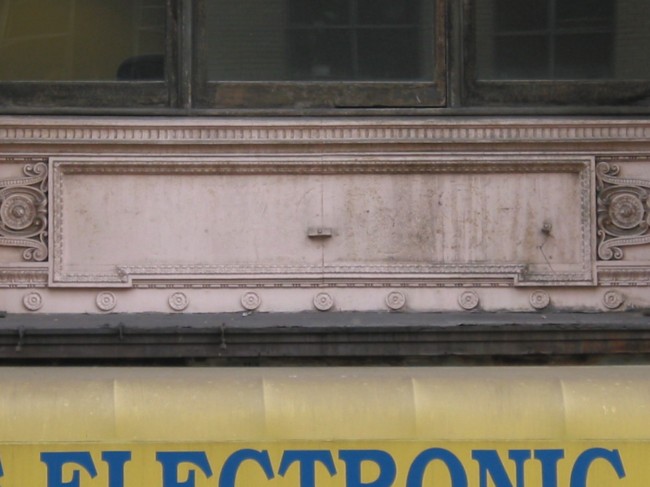
But on 14th Street, vestiges of the old R. H. Macy’s remain. A few doors east of Sixth Avenue (now called Avenue of the Americas, if only formally), look at the panel under the arched tri-panel window. It looks empty. But stare longer, and like a Magic Eye painting, you can begin to see the faint outline of the old Macy’s name, removed 108 years ago:
Find the staple-like notch in the middle of the sign. Just above and to the left, you can see the arc of the 'C'. To the right and just past the grime, you can make out part of the 'S'. Then more appears: the fork of the 'Y' in the dirt, and the the left arm of a star that once punctuated the name. *MACY'S*.
Still can't see it? Maybe this will help.
There are faint details everywhere if you take the time to look. But who takes the time to look?
Macy’s prime corner on 14th and 6th still has a role in pandering to the hoi polloi. Now it’s an Urban Outfitters that occupies a building that replaced a part of the former rambling mercantile mansion.
This Macy's red star: dubious origin, silent end
Around back, 50 or 60 feet east of Sixth Avenue on 13th Street, look a few stories up. Underneath those wings and torches, inside the shields draped in sculpted stone bunting. There, you can see faded red stars, the logo of Macy’s for nearly a century and a half.
These are a few straggling decorations from the non-stop daily parade of purchasing that made Macy’s the biggest shopping name in the world.
No one knows exactly what the red star signifies. R.H. Macy himself insisted upon it. All that’s known is that Macy worked as a sailor in his youth, and after a trip to the Far East and Singapore, he came back with a red star tattoo. Back then, it wasn’t a symbol for communism, but for hope, and many seafarers got them in far-flung, rat-infested wharves to signify their wishes to return home without perishing.
Macy’s website tersely acknowledges the star’s origin but skirts its possible meanings as well as the conditions in which he might have received the marking — mostly because no one knows. “He adopted a red star as his symbol of success, dating back to his days as a sailor,” goes the party line.
A veritable constellation of red stars has flown over your head all along. Didn't you know?
So, yes, the logo of Macy’s is based on a sailor’s tattoo, and the mark of the sort of lost, unsavory life a sailor might have led.
The red star also represented Macy’s wish to make it back home. Later, it transferred from his flesh to his empire, and now, the name Macy’s itself has found its way into every home.
And it’s still visible on the old Macy’s building on 13th Street near Sixth Avenue.
Today was a day lived at light speed. Press event, work, lunch with a colleague, more work, coffee with a friend from Tourism Australia, more writing. The frenetic pace carried right into Fox News’ newsroom. The stage manager grabs me late, and then I was placed in this seat (a new one for me) at the very last possible moment before my “hit.” Literally seconds. Earpiece in. As soon as it’s in my head, or so I think, Philly tells me that I’m on in 10 seconds.
Trouble was, the top of my head was still out of frame. For all the world was about to know, I still had hair. I relay this urgent information to the guy on the floor with none of the sense of urgency that the situation actually called for. Frame hastily jerked up, and go!
I think we were all having an off day. But it still came off — much like my IFB earpiece — even if the crush made me deliver something that was somewhat more hyperbolic than the original post I wrote about this topic for WalletPop.
As soon as I was out of the chair, I was back on the subway (which runs alongside the studio, pretty much) and in the Lower East side for the latest Restless Legs reading series. There, I caught up with a bunch of my favorite travel peeps, including the people behind Nomadic Matt (whom I interviewed yesterday on camera for WalletPop — stay tune for that), Legal Nomads, Budget Travel, EuroCheapo, Gadling, and The Lost Girls.