Inca Trail trek to Machu Picchu, Peru: What you need to know

My recent silence has everything to do with travel. I was on The Golden Trudge.

I took a trip to Peru, where I visited Cusco and did the Inca Trail to Machu Picchu. When I tell people what I’ve been up to, many of them coo and instantly ask to hear all about it. So here are some basics that I wish someone had told me before I left.

inca trail peru

The Incas built trapezoidal doorways to guard against earthquake damage. And because they're slimming.

The Inca Trail, if you don’t know, is a pathway through the mountains that linked Inca settlements along cliff faces and in valleys. One of the principal destinations was Machu Picchu, which was a sort of university-and-palace town of its day. What we call the Inca Trail is actually just 26 miles of what was once a paved man-made system of roads that threaded up and down western South America. Its paving stones were laid more than five centuries ago. These days, tourists do the 26-mile segment of the Trail in about four days of steady up-and-down walking, although shorter snippets are available for wimps and pussies.

Like several other precious attractions in South America, such as the Galápagos Islands, you have to be guided to get in. So like it or not, even if you elect to carry all of your own clothes, you will need workers to get you onto the trail. They carry your food, your tent, the cooking implements — and they carry it back out again, too. No one takes the Inca Trail alone.

The first thing to know is that not all tour companies are equal. Many of them will appear equal to the visitor, because they all strive to provide essentially the same service. But they differ behind the scenes. Peru is a nation of subsistence living and few worker protections, and those two facts combine to create an ideal environment for exploitation. So you must make sure the company you pick pays their porters fairly.

Our guide, Hubert, is from a farm town in the mountains. He’s been working the trail off and on for about 11 years. When he began, he was 19, and conditions were deplorable. He was tricked into carrying a leaky kerosene tank, and at night, he was told to go find a cave to sleep in. The conditions were so humiliating that he swore he’d never go back onto the Trail again. But with time, the Peruvian government realized what was happening, and to both protect the Trail and to protect Peruvians, it began to regulate more carefully, starting by implementing a humane weight limit for each porter. The fuel source was changed, too.

Hubert came back as a porter, a job that requires men to race past all the tourists with 50-pound packs on their backs and set up camp at the next night’s base by the time they catch up. Eventually, Hubert went to study English and tourism in Cusco, which enabled him to rise to the level of group leader. Now, he’s in charge of the displaced farm boys who are starting as porters.

Hubert swore to us that his company, Peru Treks, was one of the best, and in saying it, implied some rivals were secretly unethical. He said it pays even its lowest workers fairly, and instead of bundling the company profits out of the country, as so many tour companies do, it re-invested in Peru. Hubert said the company even helped build schools in impoverished hometowns of some of its porters. I saw our porters sleeping underneath our restaurant tent at night, and they talked and laughed with each other by night, so I can only assume he meant what he said and they were well treated. They seemed content.

Peruvian trekking companies are some of the most active spammers of American message boards, and part of the reason is tourism is an industry that’s till in its infancy there. Not everyone understands what good form is. They just know what tourism dollars can mean to their communities. I came to Peru Treks through the recommendation of an American acquaintance who recently moved to Cusco after living in Los Angeles for many years. If a company was a swindler, she would have heard about it.
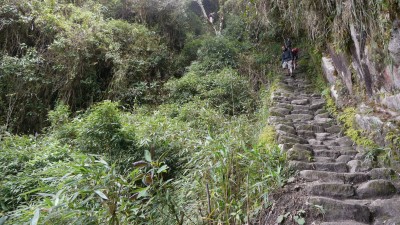
inca trail peru

Ankle-breaker: The Inca Trail has far outlasted its warranty

My tour company promoted very clear communication in excellent English from the very start. One oddity was that it demanded it was paid in U.S. dollars that were absolutely, positively, unquestionably perfect. No rips, no matter how teeny, would be tolerated. Apparently, it’s the only way a Peruvian can ensure a dollar is accepted at the bank. This took some doing on my part. First I had to get immaculate bills from my bank. Then I had to get them to Cusco in the same condition. I accomplished that with a money belt. Two of my bills had mini rips that I hadn’t even seen before, but I had thought ahead and had extras. My trek cost a total of $505. That was a $175 deposit (by PayPal, months ahead), and the rest in cash in Cusco. For that, all my meals were prepared for me, I had a tent (shared with a friend) over my head, and a guide to keep tabs on each member the group as we walked, at our own speeds, over the Trail.

I saved $15 by bringing my own sleeping bag (a Lafuma rated to freezing, and I was cozy every minute), which was lighter and smaller than the one the company would have provided. That’s important because the company’s bags weigh two kilos, and you’re only allowed to saddle your porter ($40 if you use him) with 6 kilos. One kilo goes to the sleeping pad, which they supply.

Bringing a lighter, better sleeping bag allows you more breathing room in packing. More things to pack: a flashlight and a spare, compression shorts for every day, big crazy fat thick hiking socks for every day, sandals for visiting the gawd-awful fetid holes that are offered for toilets, wet wipes for the butt at said sewer maws, some Clif bars or something (Customs didn’t seem to care). Bald guys, pack a sweatband for your head. Bring clothes that layer, because it’ll go from cold to hot in 30 minutes, especially in the morning. Bring earplugs because the tents are staked beside each other, and after days of strenuous exertion, even girls snore. Don’t bring reading material; you won’t have the energy, the light, or the will to be distracted from your surroundings.

I packed but didn’t use (but would still bring if I were you): moleskin for blisters, Potable Aqua for purifying water (you can buy bottles at way-stations along the way, and sometimes the crew boils water for you). I wish I had brought a truly waterproof jacket, not a kinda waterproof one that I had. You want the water to bead off you, because it mists and rains here and there, and you don’t want to have to bother with a plastic poncho. You can buy a walking stick (really a broomstick with a fabric tip) for about $2 on the morning you start — don’t neglect it, because it will become your third leg, and you’ll wear the bottom to a nubbin.

Cusco is at a very high altitude. Way higher than Tahoe or Albuquerque or anything American. When I first got off the plane, I saw a few faint stars for some minutes as my brain struggled to recalibrate its oxygen needs. They even sell oxygen canisters by baggage claim, although I think they’re intended more for panicky types than for actual medical amelioration. Some of my traveling companions made some classic early errors: they ate a lot (altitude causes you to digest slower, since your blood is working harder to oxygenate), and they got really drunk (I won’t say who, but one companion had a double-digit number of drinks that first night). Even if you can easily do that back home, those mistakes can cost you at altitude. Fortunately, after three drinks in four hours, I went back to the hotel (Rumi Punku — it’s lovely and pristine and I recommend it) to play Angry Birds. I don’t like finding my limits the hard way.

Every day of the trek involves getting up at the crack of Mother Nature’s ass. You will not sleep in. You will go to bed shortly after dusk daily. You will want it that way. That’s because the physical demands are tough. The food will be very good for the sparse resources available, but it will not be rich. There will not be beverages served with dinner (bring your water bottle), but there will be tea and lots of it. The guide tries to stuff you full of tea at every opportunity because you need to stay hydrated.

The first day of the Trail had a few fleeting moments of ardor, but we all knew that Day Two was going to be the real killer. Anyone without hiking and climbing experience can do the Trail, but you’d better have a few things. One is a patience for stairs. More than once, we wished the Incas had invented ziplining instead, because just as soon as we’d slaved to mount a never-ending spindle of stairs threading up to some heavenward vanishing point, we’d have to descend on shaky knees on the other side. Losing everything you’ve just gained, knowing full well you have to regain it somewhere down the line, is positively Sisyphean, which is to say negatively.

inca trail peru machu picchu

The Golden Trudge of the First Pass (Dead Woman's Pass) is behind me! I wore my Nepalese trekking hat for luck

The first thing you do on Day Two, right out of the sleeping bag, is start climbing, because the first and most difficult of three passes is ahead of you. And it goes like that for hours. I have to say that if I had truly known how much of a struggle Day Two was before I signed up, I might not have signed up, which is why I hesitate even discussing it, because you should ignore what I’m saying and sign up.

Up, up, up, as trees gave out and I found myself on a cliffside, looking down at alpacas and feeling jealous that they got to stand there and eat grass.

The air got thin as we approached 14,000 feet. There’s no predicting how anyone will handle altitude. I was a decided middle-of-the-packer, but even the front of the pack could only walk at a pace of about a foot every two or three seconds, and then stop to catch some breath every minute or so.

I started calling the hike “The Golden Trudge” because I knew what was coming at the end. My nickname gave me permission to admit it was grueling, but it also reminded me that it was do-able — and worth it. (And it was, on all counts.)

I would have had a harder time if the group had always been together. But everyone goes at their own speed, and every 90 minutes or so, the guide waits up for everyone to bunch back up again, drink water, and cool down.

It reminded me of one of my favorite maxims: “How do you eat an elephant? One bite at a time.”

By late morning, after cruel periods during which the destination seemed to stretch away from us with every step, we had bested the first pass (high fives all around!), and we knew it wouldn’t get any worse than that. And it didn’t. The worst had passed. I for one have no issues with coming down — it’s up I hate. But if you do have Going Down problems, get ready for Day Three, because after some truly wonderful passages through jungle paths and through an original tunnel carved by the Incas, there’s a long segment that’s said to include 2,000 steps down, as jangled as the porters’ teeth. Every time you put your foot down, you’re navigating around a messy fracture. Every moment’s an ankle-breaker.

So make sure those shoes have ample toes, or you’ll mash your toenails with the repeated downward motion.  Test your shoes before leaving home to make sure you can point them down an incline and still feel comfortable. (I am now so in love with my shoes, which were Keens from REI, that I’ve taken to wearing them when I’m on Fox or out at bars.) Those thick socks will help, too. Day Two is the most grueling day, but Day Three is the longest (11 hours– but Day Three is so beautiful, and so full of heart-filling moments that the first two days weren’t, that I not only didn’t feel like it took that long, but it also made me resent Day One for being so relatively lame). What would take me four days, some maniacs do in six hours on the Inca Trail race. I envy their bodies but not their brains.

machupicchu

Our walking sticks were our best friends. They started new. By the end, they looked like this.

Then there’s the matter of coca leaves. At the start of the trek, you’ll be given a chance to buy some, and you’ll wrap 8 or 10 leaves around a morsel of lime ash that acts as a catalyst to release the mild stimulant that Peruvians have been using for centuries. You will stuff that packet in your cheek and drool, annoyed, while you wait to feel like Cheech and Chong or something. But you will not feel stoned. They are not the same as cocaine; that’s the result of a scientific refinement process that some Swedish guy came up with. In fact, I couldn’t be sure if I was feeling the effect of the coca leaves or the effect of altitude and exertion. It was that faint. Then again, lots of drunks don’t realize they’re drunk, either, and if the Peruvians swear it helps them climb mountains, I guess I’ll have to believe them, because I saw them haul past my ass with 6 kilos of my stupid crap on their backs.

Yes, for sure, they deserved tips. Some people say that the Peruvians are better built to handle altitude — something about good calves and oxygen-rich blood — but I’m not so sure people don’t say that to get out of a decent gratuity. Peru Treks was clear about everything but this, partly because it probably doesn’t want to come across as greedy. Its instructions on how to tip the staff was confusing, and if laid out on paper looked like an algebra formula.

All 16 of us spent some brain-bending moments deliberating on what an appropriate and human amount would be for everyone. I think we settled on the about 55 sols total for each porter, and about 15 from each person for the assistant guide, and 30 or so from each person for Hubert, and I forget what for the cook, but it was good because we loved his mad mountaintop skills. I think there were around 22 porters to consider, and I think that when all was said and done, each of us distributed about 100 sols amongst the staff. That’s about US$35. It’s nothing considering how hard these Quechua guys work — up before us, asleep after us, beating us up the mountains in sandals — and the fact that we have so much and they have so little that they are willing to leave their families for days at a time to do this work in the elements. We gave each porter his share, pressed right in his hand, so that there was no chance he could be cheated out of it by his colleagues. It also was humanizing to recognize each man as an individual. (Actually, I’m surprised that thinking about this, and about the looks on their faces, has brought tears to my eyes.)

Whatever it we gave, I didn’t feel like it was enough, but few of us had planned well enough to have loads of cash. Most of us were out, because we forgot how much water we would drink and that it would cost another 2 sols for every day we walked deeper into the mountains: 4 then 6 then 8 then 10 for a bottle. If I were to do this again, I’d have at least $50 American (about PEN 140), if not more, just for tips. More, preferably. Consider it part of the budget, because really, it means far more to them than it does to you.  You should also have it all in the local currency, since many of these guys don’t even speak Spanish, let alone have access to a bank. (The local bills don’t have to be as minty fresh as the greenbacks do.)

I’d take about 300 sols into the mountains. That lets you err on the side of abject generosity when it comes to tipping, and it gives you a buffer to buy lots of water, and also to buy a meal for yourself in the town of Aguas Calientes after seeing Machu Picchu. Meals there are pricey — in the mid-20s and low 30s for a main. Although there are ATMs in town.
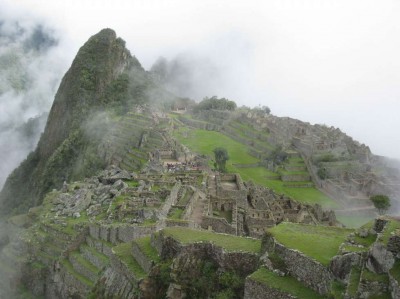
machu picchu, peru

The clouds lift, giving me my first glimpse of Machu Picchu

The last day, you’re up around 3:30, which sucks. Then you’re waiting in line at the back gate of the Machu Picchu park entrance, which also sucks. Then, at 5:30, you’re in, and you hike two challenging hours (which Hubert had lied about, calling it “a gentle up,” which sucked) until you reach the Sun Gate, which overlooks the ruin. When we arrived on the Incan-made structure at the rim of the mountain, it was raining. And the clouds below meant we couldn’t see a thing, although despite the cover, we could sense an enormous empty space below us. “It’s over there,” Hubert promised, but frankly, after 25 miles of mountain hiking, we’d tackled so many other obstacles that we really only envisioned Machu Picchu in the abstract, anyway.  I’d almost forgotten that it was the point.

We walked another mile or so, and the we arrived at the top of the ruin. It was still cloudy. It wasn’t visible. Hubert told us to wait. “Just wait,” he promised. And sure enough, the clouds teasingly lifted, giving us our magical first look at the object of our desire.

Is there something else you’d like to know? Ask it, and if I can, I’ll answer it.

machu picchu

The goal. All pain instantly forgotten, all accomplishments cherished.

The Statue of Liberty is an Embarrassment

At least, it was when it began.

It was in the Depression of 1873. A few years before, a bunch of greedy New York bankers artificially jacked up the price of gold, causing a financial panic and sending America into a slump that lasted for years. (Sounding familiar yet?)

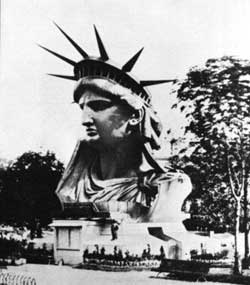
Going topless used to be more noble in France

Anyway, at the time, France was best buds with America, or at least it was better at pretending to be. It had helped us win our own Revolution less than 100 years before, and French war heros such as Lafayette were still household names Stateside. Back when getting a statue was the equivalent of landing a Nike endorsement contract today — the highest honor a society could bestow — someone European got the idea that there should be a statue to freedom. Things were looking dicey in France at the time, and America had just come out of its own Civil War, which finally emancipated the slaves at great cost.

Suffice to say that at that time, freedom was looking a lot like something that ought to be preserved as a statue in case we forgot about it once and for all. (Still not familiar yet?)

It was decided that the French and the Americans would go Dutch. The body of the statue would come from France while America would foot the bill, so to speak, for the pedestal. The sculptor, Frédéric Bartholdi, built some of the torch-bearing arm as a sort of teaser for the final thing.

In 1876, the right hand of the Roman Goddess of Liberty, which knew not what the left was doing because it didn’t exist yet, was uncrated in New York City’s Madison Square. It was hoped that the sight of 12-inch fingernails would inspire Americans to donate money to the construction of the colossus.

But there it sat, by the side of the road, a hand eternally begging.

That begging hand of Liberty sat there for longer than anyone could remember. It became a nothing but a big joke, and an embarrassment. A colossal embarrassment, in the literal sense. No one could afford to donate. Worse, they thought it was in poor taste. The newspapermen, who were the Bill O’Reillys and Gawkers of their day, mocked it every chance they got: Americans shouldn’t let the French build their monuments, they said, and everyday Americans shouldn’t have to pay for New York City’s follies, and we can’t afford frivolousness like this in these times. Even the committees assigned to raise funds never met. It became hard to tell if Americans didn’t care about freedom, or if they just had very specific tastes in neoclassical anthropomorphic polythestic art.

New York parks have always been weird places

The depression ground on, and still that stupid hand stood in the park, weird and brown, just feet off the ground, ignored like hallway furniture. Meanwhile in Paris, Bartholdi tried displaying a disembodied head to get crowds excited (well, it worked with the guillotine). But apathy reigned.

It was the age of the railway barons, but no big donor stepped forward to give the goddess of Liberty her perch. Not a big grant from the ranks of the Robber Barons like Cornelius Vanderbilt, from the entrenched political machines like Tammany Hall, or from art collecting titans like J.P. Morgan.

In the end, that creepy hand gathered scorn in Madison Square for six long years, which is a very long time no matter how you look at it, but is a stubbornly long time to endure blistering P.R.

It took nearly 20 years for Liberty to find her place in New York Harbor. She was paid for the hard way: penny by penny out of the savings of a people clawing their way past the nightmare of the Civil War and a chilling economic depression. After one newspaperman, Joseph Pulitzer, pled its case in the press, some 120,000 people contributed, many of them schoolchildren. Most donations were less than a dollar. Mind you, it’s entirely possible they just wanted the ugly thing taken out of their park once and for all, but regardless of why they did it, people got together and bought Liberty a pedestal.

Naturally, when she was completed, the pinstripe-suited crowd jostled each other to be first in line to take the credit. There was a parade, showered by the ticker tapes of the financiers who had mocked the high-minded project from the start. President Grover Cleveland, busily hurrying toward his well-deserved posthumous anonymity, arrived in New York to mark the occasion.

The lesson, of course, is to always be patient. Things will change. Laughingstocks can become icons. Even when things look bleak, or when you can’t envision the path forward, or when your idea appears to be so detested that all hope is gone, you can eventually come through and create something enduring to be proud of. Liberty can take its sweet time.

She couldn't get a hand, not even stereoscopically


I’m on a Black Friday video bender! I’m blackwashing this entire land!

Most good publications have something called an “editorial calendar.” That means the editors have a list of topics they want to cover during the year, partly because people want to know about them at those times, and partly because it’s when advertisers are most interested in paying for ads for stuff about that subject matter. Come to think of it, those are pretty close to the same reason.

Anyway, one of WalletPop.com‘s golden subjects (along with Tax Day) is Black Friday. That’s the day after Thanksgiving, when Americans bum rush box stores in search of big discounts. Same people get so worked up about the possibility of a good deal that they camp out all night just for the chance to wake up at the crack of Mother Nature’s ass and kill a Walmart employee.

WalletPop has been sending me out in front of the cameras (and in front of keyboards, where I just coined the word “blackwashing”) to discuss Black Friday with a wide audience. Unfortunately, a wide audience usually isn’t available, but there are plenty of people who live in Philadelphia and read WalletPop. I’m posting three of my recent pulpit moments about Black Friday right here.

If this first segment doesn’t attest to my CBS News Sunday Morning leanings shamelessly enough, my YouTube channel might bear sweeter fruit, often with the gentle tropical aroma of Steve Hartman or Bill Geist:

That video you just watched normally resides in a post I wrote for WalletPop which includes several other facts that didn’t make it into the final cut. (Can you believe it? There are actually DVD extras for these adorable little Internet skits!) Specifically: details about the several Black Fridays of the late 19th Century, including the one that sparked the 20-year Long Depression. Yeah. I can’t imagine why those tidbits about archaic aspects of the global financial industry weren’t deemed jaunty enough for this cut, either.

I’ve become satellite buddies with good old Thomas Drayton over at Fox Philly. Every Wednesday evening on my weekly segment, he crawls into my earpiece and asks me the questions that prod me to guide savvy shoppers in the right direction, or at the very least, shamelessly work to spread usage of my made-up word “blackwashing” across this fine, free-spending land of ours, as I craftily did in this segment:

Tonight, I paid another visit to Philadelphia via the airwaves of inner space. Once again, I essentially warned American shoppers not to be idiots and to take a little responsibility for themselves. After all, now that pretty much every major retail brand leaks — or, more accurately, pretends to leak — their Black Friday circulars, people really have no excuse not to know in advance whether any Black Friday “deal” is really a phony markdown off a phony markup. Come on, shoppers. Hear me preach it:

Oh, what the hell. I’m putting it out there in the universe, Oprah-style:

We leave you now with the radiant logo of my favorite show…


The corporation commands you to admit it’s 1:37 pm

Long before you lived here, America was a land of many towns. Our expansive “agrarian society” was barely a society at all, really, save for a loosely connected sense of similar place and purpose. And each place had its own time on the clock.

The view of the 10:22 from the locomotive of a departing 10:19

When it was 9:00 am in your town, it could be 8:42 in the town next door. It had to be that way, because there was not yet a way to unify our communities — no widespread phones, no telegraph to speak of — and the sun itself could only indulge men on the ground with the roughest sense of its place in the sky.

Many cities in the world, such as Edinburgh, Ottawa, and Hong Kong, could induce their citizens to agree on the current minute by means of cannons fired daily at noon on the dot — “noon-day guns,” they were sometimes called, some of which still operate out of the undying human demand for nostalgia and tourism (one scared the crap out of me daily at lunchtime when I lived in Cape Town) — but across the vast unsettled land of America, cohesion was still a dream.

The difference of a few minutes really didn’t matter much when it took an hour to travel two miles, and when the main daily pressure would have been to get you business done by dark. But when the trains began running, the shuffled deck of our various systems became a true mortal threat. A train couldn’t leave one town at 9:00 and arrive in the next one at 8:43. Apart from severely confusing the passengers and creating schedules a foot thick and requiring conductors to use an abacus, there was a real opportunity for collisions.

So in the 1860s people began agitating for everyone in America to adopt a standardized time system. Many of them stood to make a fortune from the new steel highways, as many men did. It started with a joker named Charles F. Dowd, who was the head of the Temple Grove Ladies’ Seminary in Saratoga Springs, New York (back when upstate New York was still a world player thanks to the Erie Canal — but the trains, ironically, would soon fix that). The year the famous Golden Spike was sunk into Utah, Dowd started pressing for the adoption of four American time zones. And to get those accomplished, we’d have to start putting our heads together on what time meant to us. We’d have to pin it down, once and forever, like a butterfly under glass.

Hill Valley never quite adhered to standardization

It took a while. Americans didn’t really object to the hands of the federal government on their pocket watches, largely because the proposed change was at the behest of the newfangled railroad companies instead. As the equivalent of the Internet companies of their time, they had lots of devotées — most of whom conveniently overlooked the drawbacks and consequences and instead fixated on the benefits of the brave new world they could bring.

But by 1883, we had the tools we needed to proceed. The telegraph was established enough so that signals could be sent between towns and clocks could be adequately synchronized. The National Railway Time Convention was held, and it was agreed that November 18 should be the day that time zones were implemented and everyone’s noon would be noon. It was called the “Day of Two Noons,” after the places that would have to live through one noon before correcting themselves to the “right” one, forevermore.

The day passed, and apart from a little Y2K-style fretting that the seams of the natural world would come unsewn, everyone peaceably made their adjustments and forgot about it. It was completely optional, yet we all agreed that, for the sake of a greater good, time itself should be redefined.

How I admire those old Americans for their good sense.

In that case, industry led the advance of the greater good. The train companies put us all on the same track. A recent episode of PBS’s History Detectives uncovered a clock that was used as a timekeeping nerve center, keeping precise time for train stations throughout the Midwest and Mid-South.

The Williamsburgh Savings Bank, at the foot of the Williamsburg Bridge, still flaunts its naughty 'H'

Unfortunately, the mania for standardization was contagious, and in 1890, President Benjamin Harrison (who will never be an action figure) convened the Board on Geographic Names. As described in Bill Bryson’s superlative Made in America, the Board’s mandate was to beat the individuality out of the rich tapestry of eccentric names that America had cultivated for itself over the centuries. The Board’s job was to command all government agencies to spell things its way. Fierce Americanization was the order.

Prior to 1890, British spellings in place names was far more common. After all, at that time, many of our grandfathers would have been born British. But the Board beat the Centres in to Centers, suffixes of –borough were dulled to -boro, and sprightly hydra-headed New Castle and La Fayette were tamed into Newcastle and Lafayette. San José was robbed of its aigu, thus excising the Spaniards from the story of what they began.

The Board and the Post Office lost one notable battle. In 1891, the edict came down to start using Pittsburg. The city, no doubt puffed up with steely pride, refused. Not the University, not the Stock Exchange (which existed, and which during the city’s industrial heyday wielded considerable power). For 20 years, the Board and its arbitrary grammar police commanded the loss of the rambunctious H. It never took. On July 19, 1911, Pittsburgh, with that wasteful 10th letter, became the official spelling per official law.

But most places in America complied, perhaps out of a starry-eyed wonderment for the brave, uniform, industrial age they were supposedly enjoying. I wonder how many towns would sooner burn to the ground than comply with a government order like this today.


The Disney Store Times Square opens. I’m without words

On Tuesday, the Disney Store makes a triumphant official grand opening in Times Square, shutting down the so-called “Crossroads of the World” with an appearance by a rodent that’s huge even by Manhattan standards.

The store has been open to customers for the past few days. I went, and although I’m pleased to see that something is finally taking over that eternally empty Bar Code arcade space, the geek in me found little to hold him in the two huge levels of merchandise.

You wouldn't know it, but Mickey is older than two of those iconic buildings.

When you walk in, you will be reassured by piles of banal New York City stereotypes: tee shirts with yellow cabs, big apples, Minnies who have stolen Lady Liberty’s crown. You can even buy Spider-Man action figures now that the Mouse-Marvel marriage is complete.

How appropriate that there’s a Disney store in Times Square! After all, the neighborhood played a central role in the career of Walt Disney himself (isn’t that how you have to describe the Disney Diety now? “Walt Disney himself”?). After all, Steamboat Willie premiered at the Colony Theatre (now the Broadway, where Promises, Promises is playing) on November 18, 1928. And he World’s Fair of 1964, in Queens, was where “its’s a small world” was born (the original is now at Disneyland) and it was the father of Epcot.

You’ll find nothing at the Disney Store that would tell you any of that. In fact, you won’t even find a single piece of information, not even for sale, about what happened where you are standing. Buzz Lightyear costumes, princess outfits, Vinylmation allowance gobblers… but not a single page in a single book about Disney art, Disney animation, Disney history, Disney biography. I know because I asked three employees if there were any.

Hat's entertainment

“Oh, I have some really great Disney books at home!” chirped a very young woman (everyone who works there is about 21 years ago, which usually tells you something about the wages). “But we don’t have any here.”

Yeah, I know. I’m being crazy. I shouldn’t expect a profit-making enterprise to give up even a foot of floor space to something that may not make much money. The Disney Store is a money machine, not a museum. I’m too sensitive. I demand too much morality from my publicly traded companies.

And I do. The American memory is failing, and we’re standing on the shoulders of previous generations just so we can reach the momentary purchases on the top shelf.

It’s a hot button for me. And it’s the modern Disney company for you. Up until three years ago, there was a single, solitary bookstore in all of Walt Disney World at which you could reliably find books about the great achievements upon which this billion-dollar empire rest. But then the stewards of that empire converted it into a Hanes-sponsored tee-shirt shop.

After it closed, I went to The Emporium, the largest souvenir store on the Florida resort property, and asked a worker (elderly) where I could learn about Disney and how it got that way. She told me I could maybe find some stuff at the Virgin Megatore. I went. I couldn’t.

Now even that store is closed, so there’s truly no dedicated bookstore or even bookstand on Walt Disney World’s 30,000-odd acres to purchase a book about the craft that brought you there.

Walt built this, but don't tell: The new store

I don’t mean to single Disney out. Almost all the major American parks dishonor their own heritage. Many Hollywood studios do, too. I recently took a tour of the Sony Pictures Studios lot, which was once the mighty MGM, and although I begged the guide for background about the things that were shot on the soundstages I visited, I got mostly shrugs. He could barely name anything that Sony didn’t want to sell at the cinemas or on DVD. (“Spider-Man?” he offered.) Then again, in the 1970s, even MGM itself dumped most of the historical evidence of its formative and glory days into a landfill. Entire movies were lost forever. Last week, MGM went bankrupt once and for all, and now there’s no one to play steward to its legacy unless there’s a buck in it.

When Cypress Gardens opened in Winter Haven, Florida, in 1936, it put Central Florida on the map. People came to the godforsaken Florida swamp from thousands of miles away to watch its water ski shows, in which pyramids of pretty girls, bearing flying pennants, soared past gathered crowds snapping Rolleiflexes. My great-grandfather, Tracy W. O’Neal, was a newspaper photographer, and his albums (part of his archive is at Georgia State University) was full of images from Cypress Gardens because the spectacle was so singular.

Cypress Gardens changed the destiny of billions of people, not just who have ever lived around Orlando but also who have ever vacationed there. But when I paid a visit to the park four years ago, there wasn’t a lone historic postcard, book, magnet, brochure, or sign noting it. Not even gathering dust in a corner in the otherwise deserted gift shops.

Cypress Gardens, which so dishonored its place in American culture, closed permanently soon after. Now Legoland is taking over the property. I fervently hope they can find at least six inches of shelf space between the personalized key chains and jelly beans to remember what brought us all to this place.

I’m fond of saying that if the Disney parks ever closed, the National Park service would have to take them over. They are that central to our national identity and our shared experience as Americans. Is there anything else we all have in common, except maybe Pop Tarts and Pringles? And when you are the stewards of such an intensely historic, culturally indelible enterprise, I think you have a moral obligation to honor it and share the history.

Cypress Gardens' famous Florida-shaped pool: They'd rather you never saw this

Sure, Disney has a membership club for fans, D23, but it comes with a steep annual membership fee. Besides, it’s for people who already love the history.

Country music fans, interestingly, are really great at preserving their cultural heritage despite the fact the genre is a commercial enterprise. Sun Studio in Memphis has been meticulously maintained. The Country Music Hall of Fame in Nashville is gorgeous. You can even visit Jerry Lee Lewis’s house, which I regrettably have, because I saw a dead mouse in a wine glass in the dining room.

Some parks are better than others at honoring their position in the history of American recreation. Many of them, oddly, are in Pennsylvania (Kennywood in Pittsburgh, Knoebels in Elysburg) or Europe (Tivoli Gardens in Copenhagen), but all of them have something in common: a devoted local fan base. That may explain why Disneyland in California is the lone Disney property that’s getting good at it. Its guests tend to be more of a hometown crowd and are more likely to spend their money on nostalgia items.

But many of our greatest national entertainment brands are well past nostalgia. They are part of the American fabric. Unfortunately, their bosses are more interested in continuing to capitalize on the product than take a few inches of shelf space to thank the forebears who changed the way the world dreams — and laid the groundwork for their fat paychecks.


‘Scottsboro Boys’ protest: It Ain’t No Minstrel Show

Today was the only time I have ever had to cross a protest line to see a musical. As I approached the Lyceum Theatre on 45th Street for today’s matinée of The Scottsboro Boys, I could see the shapes of banners, and I could hear a chant emerge from the noise around Times Square:

Scottsboro Boys is no minstrel show!
Shut ’em down! They got to go!

Most Americans are not familiar with the Scottsboro Boys anymore. That in itself is a good reason to write a piece of art about them. Most Americans are also not familiar with art anymore, either, though, which is these protestors’ reason to protest.

Although I’ve never had to break a picket line to see a musical, I’ve also never seen the area in front of the theatre so empty before showtime. A line of police between the shouting protestors and the entering audience kept the area clear, and once inside, most of the patrons hastily took their seats, not wishing to engage in a potential fray. Something about the moral challenge of a protest line can instill a sense of quiet shame in whomever is on the other side, even if they have nothing to be ashamed of.

'The Scottsboro Boys' protest: Racism reversed

I was one of the few theatregoers who asked for a leaflet from the protestors, who identified themselves as being associated with something called the Freedom Party (tellingly, the name of the group was written much more prominently on signs than the substance of its complaint about the show). As soon as I read it, I knew these people didn’t understand what was actually happening inside this theatre.

The musical authors of The Scottsboro Boys are songwriters John Kander and Fred Ebb. Kander and Ebb crafted a career out of writing about issues of injustice and personal freedom, including Kiss of the Spider Woman (1992), Chicago (1975), Cabaret (1966), and Flora, the Red Menace (1965). Both writers were children of the early 20th century but their work possesses modern sensibilities, so (generally speaking) it uses vaudeville or burlesque styles as a counterpoint to modern themes. That’s how Roxie and Velma can winkingly wrap up Chicago for us by singing ‘”in 20 years or so/ it’s gonna change you know” and how Cabaret‘s satanic Emcee, a stand-in for rising Nazism, insidiously mocks the blithe characters around him simply by singing a song that appears to be, on the surface, cheerful and depraved.

It’s called a “concept musical.” Kander and Ebb’s work uses the jolly tunefulness of American musical traditions as a weapon against the lies with which America, and humanity in general, flatter themselves. In The Scottsboro Boys, which retells the true story of nine young black men falsely convicted of rape in 1930s Alabama, they (with bookwriter David Thompson) have taken for their language that most poisonous, all-American musical form: the minstrel show.

Toe-tappin', cotton-pickin' American ugliness

Artistic patriots cherish the all-American genres of jazz and musical theatre, but minstrelsy is America’s forgotten grand tradition. Blackface was once dominant in our culture, but we are now too ashamed to so much as hint at it. In it, singers (both black and white) alike portrayed African-Americans and simple-minded, lazy, fun-loving, watermelon-eatin’, chicken-pickin’ — and adorably inferior. Considering that the imprisonment of the real-life Scottsboro Boys depended on exactly such toxic assumptions about them, minstrel songs are an apt idiom for the tale.

Even the title is apropos. “The Scottsboro Boys” is not the patronizing name Kander and Ebb have given these men, although the diminutive nickname instantly indicates the show is about the dehumanization of racism. It’s the actual patronizing name given to these men in the ’30s by do-good liberals who took up their cause (and later dropped it, when they tired of it) in the North. In the South, all black men were called “boy.” White men, of course, were “sir.”

“You’re not allowed to write about that”

Would the Freedom Party complain that Cabaret is about Nazism, or do they object to the show’s pointedly anti-Semitic number? No, and the protest against The Scottsboro Boys clearly seeks to divide along racial lines. The flyer reads, “white producers, writers, directors, and the media are attempting to turn Black people’s [sic] suffering from racial terrorism into a mockery. They think by hiring a Black case they can cover up their insults by claiming “Blacks work here.” YOU CAN’T – the plantation is the plantation.” To these people, art is exploitative if it’s about something that happened to someone else.

“When is Racist Terrorism Musical Entertainment?” asks the flyer, under photos of the real Scottsboro Boys and a horrifying Xeroxed copy of a real-life lynching. “Where is the Song and Dance Musical about Gas Chambers, World Trade Center or Japanese Internment Camps?”

It’s funny they ask that. There have already been World Trade Center musicals. A college classmate of mine, Elizabeth Lucas, recently directed Clear Blue Tuesday, a film musical written about the emotional response to 9/11. Although the songs were penned by people with direct connection to the tragedy, Lucas and her film were assailed by people ignorant of the film’s true content in the comments section of an article in The New York Times‘ blog. Most of the objections seemed to rise from the pithy thumbnail description movie musical about 9/11 than what the movie actually was: artistic expression about what happened to us then. Many more asserted that Lucas had no right to write art about 9/11 if she hadn’t personally been at Ground Zero that day.

The protestors don’t recognize that although they want everyone to honor the black experience, they won’t let any person talk about it unless they themselves went through it.

Just as minstrel acts tell us far more about the self-identity of the performer than of the people being mocked, protests like these tell us more about the shoddy state of the protestor’s worldview and prejudice than about the target.

Above nearly everything else, Americans excel at claiming they stand for one thing when, in fact, they stand for nearly the opposite. That’s what the Scottsboro Boys found in the supposedly free country of their birth, and that’s what the Freedom Party teaches when it is quite plainly in favor of anything but freedom, at least as far as art is concerned.

“You can’t do that. Otherwise you’re perfectly free.” They might as well add “boy” to the end of that, such is the sentiment about knowing your place.

The protest also teaches us that perhaps our culture has become over saturated with commercial product that few of us can identify symbolism when we see it. When everything in a society is exploitative, and when everything exists to be sold and to make profit, we lack the critical thinking skills to know when something exists simply so we can process our shared experience better.

Neither Clear Blue Tuesday or The Scottsboro Boys is likely to make fortunes, which helps remove the stigma of exploitation — but even if they were, their authors would still have the perfect right to create them, at least in the America I know, which flatters itself by telling itself it’s free and capitalist.

Back to the old Grind

This sort of protest has happened before. Spike Lee got slammed for commenting on minstrel acts in the daring but flawed Bamboozled (2000), but similar battles have  happened in musicals, too, and the battles were usually lost. Kander and Ebb themselves were forced to change a lyric in Cabaret in which a despicable character pointedly compared Jews to gorillas. And in 1985, my friend Larry Grossman, with his lyricist Ellen Fitzhugh, was forced to cut his own brilliant-anti-racism song, “We All George,” from his Broadway musical Grind. The premise of the song, a peppy ditty, was akin to the word “Boys” in the Scottsboro Boys: Since white men think all black men look alike, they need not worry themselves with the real names of their porters and bellboys, and they they can just call them all George.

The CD for 'Grind' lacks its most subversive song

It was savage, it was ugly, it was of course aware of its own hateful ridiculousness — and it made the cast so nervous they didn’t want to perform it. (Director Harold Prince, who was the one who caved on the Jew line in Cabaret, caved on this one, too. Another do-good liberal accidentally doing the wrong thing, or only willing to go so far with his principles.)

With The Scottsboro Boys, in which characters break into Jim Crow shufflin’ as a way of starkly rebutting their humanity rather than disguising it, “We All George” is now officially a quarter century ahead of its time.

But really, it’s not the line or the song or the show these protesters object to. It’s the racism itself. It’s the mirror. It sucks to admit what we all come from, because we all came out of evil.

This show has been a live wire since its inception, and it took a long time to reach the stage because of it. In fact, lyricist Fred Ebb died six years ago — on a September 11. But in The Scottsboro Boys, I imagine his hand popping out of his grave to lob one hell of a grenade at all the small, hateful minds of the world. (His committed Broadway cast and creative team cleanly pull the pin.) His most obvious targets are the racist and/or insular Americans who still control parts of this country, and the people who assume small lives can’t have large effects.

But in defiantly choosing to use minstrel songs — the old perversion gets further perverted and becomes, almost, a corrective — he’s also thumbing his nose at the small minds on our own doorstep who don’t understand satire, symbolism, or art itself. Evoking minstrels is the ultimate subversion of all-American themes that he, with Kander, was working toward for 40 years. It’s a gut punch, and I love it. I love anything that reminds Americans when they’re lying about something. We lie about so much.

It hurts to look at brilliant things

My performance, which I noticed was far more integrated than most Broadway musicals I’ve attended, had the audience hooked, eliciting more gasps and sighs than you hear at most matinées. It got a standing ovation — not unusual these days for any show, sadly — but as I left, I listened for the reaction as people started talking to each other. More than once, I heard voices say they didn’t get what the protestors were complaining about.

The protestors, I also noticed, didn’t have the courage to be in front of the theatre after we came out, disarmed of our ignorance. It’s a good thing, because they would have earned themselves arguments from more than a few people who were devastated by their first exposure to the story of the Scottsboro Boys.

The complaint is the same old song and dance, but in a new costume: People who allow a simplified phrase such as “musical about the Scottsboro Boys” to define the width and breadth of their understanding of the topic. People who think in headlines and bumper stickers and tweets and respond in what they must assume is useful outrage. Prejudice of any kind is repulsive indeed, but like minstrelsy, it says more about the actor than the object.

The protestors are correct about one thing: The Scottsboro Boys certainly ain’t no minstrel show. But thanks for the publicity, sirs.

From the Lyceum's lobby, but only before our education

Update: I read a little more about the show since writing this, and I learned that after Ebb died, John Kander finished the project by uncharacteristically writing a portion of the lyrics himself. I have to give him more credit. I’m also not satisfied with the credit I didn’t give to director Susan Stroman, whose flourishes (Haywood’s coon song affectations in “Nothin'”, the fierce group bum rush and roar at the climax of “The Scottsboro Boys” song) immeasurably enrich the show with razor-sharp double meanings. Their contributions make the intentions of the whole searingly clear. Simply listening to the cast album, which spotlights the songs divorced from their talents, proved that to me.

[I think I have a way of exploding with thoughts after seeing important Broadway musicals. I wrote this post (click here) in 90 frenzied minutes after seeing Lincoln Center’s marvelous South Pacific revival.]


My in-depth Ken Burns interview

My interview with Ken Burns, published in time for the premiere of Baseball: The Tenth Inning on PBS, is here! I’ve chopped it into three bits for your digestion. Think of them as three more innings:


You may remember I was all a-titter about meeting him on the day we shot this. I was so excited I tweeted myself. I think it came out really well despite the fact I was dying to branch off into all sorts of side topics about Americana, immigration, and cultural undercurrents. Geek!